

What is Cinema?
Or How About I Break Down that Modern Social Realism Issue for You

Letter from the Editor:
After posting the last issue of Luz Films Mag on Modern Social Realism, I realized a couple things about myself that I think are hurting the effectiveness of this group experiment:
I have never really been in a long-term relationship and so I haven’t developed the muscle of sustained conversation with the same person (or group of people) over a long period of time and so oftentimes I am speaking as a monologue and not a dialogue; which can easily become an ego stroke instead of an effective use of language to engage in conversation.
As someone who didn’t think they would live very long and also as someone who has been deeply and inherently misunderstood their entire life, sometimes I subconsciously still think that I have to “do everything at once” by covering all the facets of my train of thought in an effort to be “seen” and not misunderstood and because like Lin Manuel Miranda’s Hamilton - I feel like I’m running out of time.
This again easily lends itself to an ego stroke instead of an expansive entry point.
This moment in the Hamilton musical was a little too real for me…
 Tiktok failed to load.
Enable 3rd party cookies or use another browser
Coupled with both of these subconscious threads is the fact that if I’m being TOTALLY honest - no one has particularly cared about what I have to say because it was always “too deep,” “philosophical,” or “artsy” for their tastes. So bear with me as I try to fully wrap my head around the fact that a growing number of you actually do care about things that are deep, philosophical, and “artsy.”
Alright now that we’ve got that out of the way…
I’m gonna break down the Modern Social Realism issue into smaller chunks which I will be releasing over the course of ya know time, so that we can actually actively discuss what is being talked about because ya’ll….
it’s some really really good, important stuff.
So let’s begin with why we’re all here and what we all love to talk about and celebrate -
** pulled from the MSR issue with a couple additional responses to the question that were submitted post-publishing. if you are just like actually Taylor, I really do have hours to spend reading about cinema and what we need out of our movies right now - original post is here.
but for those of you short on time, let us begin with this simple question:
What is cinema? Not a “movie” or “content” or “video” but what is CINEMA (the art) to you?
What is cinema? A prism.
To me, cinema is, on the surface, a reflection of the human condition. It is our best attempt at looking in the mirror, through space and time, and seeing all of our best and worst qualities on screen. Perhaps, even more so though, it is a “recreation” of our lives - not a perfect reflection, and not a perfect reimagining, but something in between. Here, and really only here, can we literalize our dreams, tangibly touch our thoughts and feelings, and walkaway knowing that it was perfectly captured ethereally, even though it is impossible to describe. Here we can feel the joy that we can’t describe to others and the sadness that we can’t empathize. - Will Ephlin
To me, cinema is the art of using the elements of cinematic language (camera, blocking, cinematography, editing, sound, production design, mise-en-scène, and performance) to create meaning. Where every creative choice, from the placement of the camera to the rhythm of the edit, shapes what the audience sees, feels, and understands. Whether the result is an emotion, an idea, or a story, cinema communicates through the language of the medium itself. - Amanda Sweikow
Cinema is an experience. It’s an assembly of memories. It also creates memories. It’s immersive, but it’s also more than that. It’s not just entertainment. Good cinema is more than entertainment; it is art, and artfully told stories about the human experience/spirit, in all of its glory, ugliness, and beauty. In addition, it’s communal. The movie theater is a place to connect with fellow humans over a shared experience and collective memory. - brandt
To me, cinema itself is living and breathing and has the potential to be actively engaged. It isn’t relinquished to the time spent in a dark room watching a movie or even in the lively discussion of a film with a friend… although I do love both of those aspects of it, but, again for me, cinema is how I actively engage with the world around me. It is not only the lens through which I see but it is how I make sense of and process differing realities. - Taylor Lewis
Cinema is a magic trick. It’s a story or art form just like any other medium, sure. But we feel books in our hands and flip the pages when we read; our legs grow tired when we stroll through museums; our eyes get distracted while listening to music. Cinema does not have the same conscious boundaries of immersion. It is the one art form that makes the rest of the world completely melt away. And it succeeds only by putting the truest, most authentic expressions of individual humans on the screen and the script and the speakers. It is a chorus of these artist’s experiences—the result of which is a new, comprehensive, completely unique experience that only you can have. And then, when it’s over, it disappears. Like a quarter in a magicians hand. And all you can do is applaud and ask them to do it again. - Ollie Hicks
It’s a good question to ask from both an artistic and audience perspective. I think, in each instance, the answer is the same. Cinema is a communal campfire.
Storytelling evolved around thousands of ancient campfires, long before Homer wrote about the trials of Odysseus, long before Beowulf hunted Grendel, long before Arthur drew Excalibur from the stone. Stories have always been how we humans have grappled with the obstacles, celebrated the triumphs, and chronicled the follies, foibles, and fancies of being alive.
The advent of visual depictions of events on cave walls and in pyramid chambers added imagery to stories, expanding them from purely aural (and later written) experiences. And the eventual emergence of photography and cinematography further enhanced the power of visual storytelling.
Cinema was born, an art form of infinite possibilities for showing us who we are and how we act towards one another.
Cue audio recording. Dialogue, sound effects, music: each of these elements helped turn a few seconds of primitive imagery into hours of theatrical magic. Not only could audiences lose themselves to enchanting stories and dazzling images, but they could hear actors speaking as they would in stage productions, be startled by a slamming door or creaking floorboard, and be moved to tears by swelling music.
Still, for all the new techniques and technologies that have continued to affect physical production, for the changes in distribution systems, for audiences with altered attention spans, cinema as an art form remains remarkably as it always has been: a communal campfire around which we gather to tell each other stories about the human experience. - Skip Berry
Although a part of me wanted to spend hours digging into the nooks and crannies of this question, I’ve decided to shoot from the hip instead (much more fun…)
Here’s my best shot: the use of cinematic language to tell a self-contained story that honestly grapples with an emotional truth.
I’ll briefly breakdown each element (without boring you with the small print).
First, I am using “cinematic language” as a shorthand for performance, editing, sound, moving images, etc.
“Story” isn’t the same as “plot” or “narrative.” Observational, abstract or experimental films can tell a story, even if it doesn’t follow a conventional A to B structure. What I really mean by “story” is that it invokes our imagination by transcending the specific circumstances of what’s on the screen.
By “self-contained,” I don’t mean that it can’t be part of a franchise or set up a sequel. But I am looking for some sense of internal thematic or emotional completeness, regardless of any dangling threads.
“Honestly grapples with” is my attempt to build a moat against propaganda, advertising, or the most cynical of commercial money-grabs.
Finally, Freddie DeBoer wrote a little while ago that he accesses art to find the “human underneath.” This is what I mean by “emotional truth.”
It is the core human experience of the film.

What Is Cinema? by Jordan Levenque
Few art forms shape our experience of time the way cinema does.
A photograph preserves a moment. A novel asks us to imagine one. Music carries us through one. Cinema does something stranger. It stretches time until a glance becomes a confession. It collapses years into a single cut. It lets us revisit memories that never belonged to us and somehow leave feeling like we’ve lived them. Andrei Tarkovsky called filmmaking “sculpting in time,” arguing that cinema’s true material isn’t simply moving images it’s time itself.
Maybe that’s why I’ve never been able to call cinema “content.”
Content is made to pass the time.
Cinema changes the way we experience it.
The best films aren’t just showing me somebody else’s life. They change the way I move through my own after the credits roll. I leave the theater and the walk back to my car feels different. I catch myself looking at strangers a little longer. The afternoon light suddenly feels worth noticing. The world hasn’t changed.
My attention has.
Cinema is the art of teaching us what deserves our attention.
We live in a moment where everything asks us to move faster. Scroll. Swipe. Skip. Refresh. Every day gets compressed into an endless stream of things we’re expected to consume before they disappear. Somewhere along the way, we’ve started confusing movement with meaning.
Cinema asks the opposite.
It asks us to stay.
To sit with a face after the dialogue ends. To notice the distance between two people before they embrace. To understand that sometimes the most important thing in a scene is the thing nobody says. Meaning doesn’t always arrive on cue. Sometimes it takes time. That’s one of the things cinema can do better than any other art form it reshapes how we experience duration itself.
That’s why I’ve always found myself returning to films that trust ordinary life.
Not because nothing happens in them.
Because they understand that life isn’t only lived through events.
It’s lived in the spaces between them.
A family eating dinner.
Someone washing dishes after an argument.
Children making games out of an empty lot.
An elderly man sitting on his porch while the neighborhood keeps moving.
Those moments rarely move the plot, but they move us. They remind us that a life doesn’t become meaningful only when something extraordinary happens. It was already meaningful while someone was cooking, waiting, laughing, grieving, or simply existing.
I think that’s the kind of cinema we need right now.
Not cinema that’s louder.
Not cinema that’s afraid of silence.
Not cinema that mistakes stimulation for feeling.
We need films that believe ordinary life is worthy of extraordinary observation.
Films that trust an audience enough to sit with uncertainty. Films that understand a kitchen table can carry as much drama as a battlefield. That memory isn’t just a flashback but a place we keep returning to. That silence has a rhythm. That every neighborhood has a pulse. That the smallest gesture can carry generations.
In a world constantly demanding more speed, maybe cinema’s greatest responsibility is to remind us that some things can only be understood by staying with them.
The films that stay with me don’t simply document the world.
They recalibrate how I move through it.
They teach me to look longer. To listen harder. To recognize that nothing is ever just “ordinary” if someone cares enough to really see it.
Maybe that’s what cinema has always been.
Not an escape from life, but a return to it.
An art that gives us our time back not by slowing the clock, but by reminding us that some moments deserve more of us than the world is willing to give them.
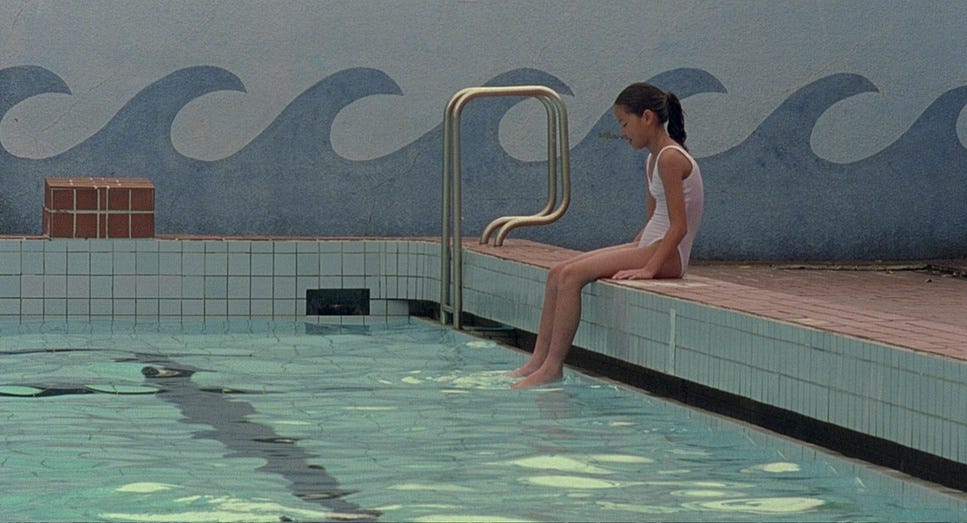
What is Cinema by Cameron Andrews
To me cinema almost feels like the natural progression of art, like what all of our art throughout history has been leading us to. It’s a full-bodied expression of what it means to be human. At different points in time I’ve compared cinema to poetry, which is something I think I’ve always felt but found the language for through Tarkovsky’s book Sculpting in Time. I think the best films are evocative in a similar way to poetry in that there is a recognizable form to them, but often they are getting at something much larger than the sum of their parts. Music is similar. It’s a collection of sounds that cohere into something much bigger. Music is poetic in that way. Music, like some poetry is also rhythmic and I pull from that a lot in my own work, especially when editing. There’s a power to the dynamics of music, deciding when to quiet down during a bridge before exploding into a louder chorus or outro.
Cinema is able to do something similar. It’s able to lull you into a sense of calm before flooding you with an almost unbearable amount of emotion. Conversely it’s able to overwhelm you and then help you find peace.
And then there’s the obvious connection it shares with photography. Undoubtedly, cinema is a visual medium (but also an auditory medium). I think part of what has made it so immensely popular in its young lifetime is that it’s able to tell us stories in the way that many people seem to primarily perceive the world, at least consciously, which is through our eyes. But I mention the relation to photography after poetry and music because sometimes I think it is seen as the most important aspect when in reality it’s not. Cinema is not literal. At its best, cinema is like poetry in the way that its form reveals the true content. The form is not the content. For what it’s worth, photography isn’t literal either, or at least doesn’t have to be.
The photography available to us as filmmakers is yet another tool. It is through the composition of these images but also through the juxtaposition of images and the sequencing of these images (similar to the structuring of a poem or song) that allows us to say what we really want to say. It is also what allows people experiencing the art to not just see but to feel. Just as what we see with our own eyes is interpreted by us, these images have been interpreted by others, allowing us perhaps to see the world in a way we may not have interpreted it. And I say images because it’s a common language to use with film but this extends to the auditory landscape as well. In a way, I guess I don’t believe that cinema is it’s own thing at all, but rather the most recent relative in a long line of art forms meant to help us express ourselves as fully as possible.
I think that cinema is our newest attempt to reach out into the unknown of everything and put it into perspective. I think it holds the most potential for truth. I think it is also likely our least developed artistic sense, and the one still with the most potential for growth.
What is Cinema? by Victoria Michele Miller
This is a loaded question. One I’m not sure I can properly answer. I was tempted to pull my copies of Deleuze and Heidegger off the shelf, hoping to refresh my memory of what they had to say.
I know I can describe what cinema feels like. What comes to mind when I see the word written on the page.
There’s a weight to it, a seriousness that makes me think about things beyond what’s on the screen. The mythology surrounding the filmmakers (if there is any, there usually is), whether it’s referential, its point of view, whether it lingers, whether it stays. But more importantly, I always come back to what it makes me feel. What is the feeling?
With films I deeply resonate with, there’s a rhythm that exists more in my body than in my mind. When I watched A Clockwork Orange for the first time, I was 11 years old, and I didn’t have the vocabulary to name what I was watching. But I felt the experience of it, and that feeling stayed with me. It opened up a new way of thinking, seeing, and understanding what a film could do.
Cinema can affect you before you have the intellectual framework to understand why.
Most great art does this, regardless of the medium. It reaches you first, and only later do you begin to understand what it was doing.
But I want to be clear that my definition of cinema is democratic. It is generous. My lens isn’t limited to auteur films, as deeply as I love them. Cinema is an art form that, at its best, reaches us on a soul level.
The harder question, then, is this: what separates cinema from a movie? Or a video? Or content? That’s the distinction I’ve been wrestling with, and the question that Taylor astutely asked.
I think the conclusion I keep circling back to is what I stated earlier: cinema makes me think about things beyond what’s on the screen. I find myself asking questions about my own life. I find myself thinking and looking things up that I wouldn’t have before. I find myself in conversation with the person I watched the film with.
Cinema creates an afterlife.
It continues to exist after you’ve watched the film. It stays with you, lingering in your memories and in the collective memory. It alters the way you look at life, even if only slightly. It makes you aware of things you were carrying that you didn’t realize were there until a character, a situation, or a moment reflected that same dynamic, issue, or burden back to you.
A movie can entertain. A video can inform. Content can capture (and many times limit) our attention. But cinema, at its best, leaves something behind. There is a generosity to cinema that extends beyond the moment of viewing. It creates a dialogue between the work, the artist, and the person experiencing it.
That’s probably the thing that can’t be measured. The thing that separates cinema isn’t necessarily what happens while you’re watching it; it’s what happens after.
The filmmaker offers something, but the audience completes it. Not because they change the work, but because they bring their own memories and experiences into conversation with it. The meaning expands beyond the artist’s original intention and becomes something larger.
Maybe that’s why cinema feels different. It is not just something we watch. It is something we encounter.
The images disappear. The credits roll. The screen goes black.
But if it is truly cinema, something remains…
It’s a Feeling: Cinema vs. Everything by Danielle A. Scruggs
What is cinema? Not a movie, or a video, or that dreaded word that evokes flavorless gruel, one that has come to mean everything and nothing at the same time: content.
No, we’re here to talk cinema.
To me, it’s akin to hip-hop versus rap.
You know it when you hear it, when you feel it, when you see it.
You know when something has been poured into, argued over, coaxed out, finessed, fine-tuned, crossed out, and brought back until the artists know it’s ready to put out into the world.
Committed to page, I write a rhyme
Sometimes won’t finish for days
Scrutinize my literature, from the large to the miniature
What is cinema to me?
It’s Juan teaching Chiron to swim in the Atlantic Ocean while storm clouds loom in the distance in Moonlight.
It’s that same ocean swallowing the men in a Senegalese town in Atlantics, who later reclaim their voices through the women left behind.
It’s Miles Davis’ “Blue in Green” slowly transforming into a wall of distorted sound as Daniel, haunted by his memories, recounts to Fonny his time in prison in If Beale Street Could Talk.
i woke up to it, heavy, alight with trueness
always a way of losin’, compelled to knew it
my body traveled, my mind waits behind the music
It’s the frenetic cuts between Henry Hill’s home life and his nightmare pursuit away from the feds in GoodFellas.
It’s the slow dance in the living room between Stan and his wife to Dinah Washington’s “This Bitter Earth” rendered in black and white in Killer of Sheep.
It’s Hattie embracing Turner but also you, dear viewer, at the same time in Nickel Boys.
Now let me pray to keep you from
The perils that will surely come
See life for you, my prince, has just begun
And I thank you for choosing me
To come through unto life to be
A beautiful reflection of His grace
See I know that a gift so great
It’s Diouana asking herself, “What am I here?” (interestingly, not “who am I?”) in Black Girl.
It’s the sheer longing on Chow Mo-wan’s perfect face as he stares at Su Li-zhen’s equally perfect face in In The Mood for Love.
It’s Sandra’s explosive monologue about her husband’s infuriating mediocrity in Anatomy of a Fall.
Life is just like a settlement waiting for you to cash on it
Life is just like a bike, it don’t move unless you pedaling
It’s Bishop’s thousand-yard stare at Q’s genuine look of terror at his locker in Juice.
It’s Tre embracing Ricky’s body, covered in his best friend’s blood in Boyz N The Hood.
It’s the gaping black maw Rudolf Höss stares into towards the end of The Zone of Interest.
And it’s my turn to settle down
Promise that you will sing about me
WHAT IS CINEMA?
by Sam Bailey
A woman sharing the history of her lovers through a mirror filled with ghosts. A philandering husband dancing with the Other Woman on a beach during golden hour. A slight of hand. A romance over craft beer. A meet-cute. A walk and talk. A fight so brutally honest the other person dies the next day from the truth. A body in the snow. A white rabbit on a shoulder. A lit cigarette through the sunroof of a car. A line dance at a wedding. A perfect needle drop. The shift of the camera that allows your brain to come up with images far more terrifying than whatever could be seen. Never just one thing. Looking down the barrel. Which means looking at me, at us. A revenge fantasy. A spit take. A seed. A seance. A close up of a gaze. A red lip, jealous eyes covered by dark glasses, an iconic stare. A yearning. Silhouettes. Shadows. Frames within frames. Fractured glass.
The way the light reflects on Black skin. Intentionally. A returning.
The craft of it cracked me open. A referential form. A dangerous one, if we let it.
Cinema is so many things. A window. A dagger. A violent weapon of conformity, of propaganda, of capitalism. A tool of revolution. A deep knowing in a cyclone of uncertainty. An art form that asks you to use all the other art forms: music and design and sound and composition and photography. Close confidantes. Collage. To twist and manipulate the forms to build a story that is both fleeting and forever. (It could be forever. If we value the voices who make it). Who gets to have their stories live forever? Whose stories are valuable? A universal language. (Who gets to be universal?) A puzzle. Recognizable. Just. A tone poem, a heartbreaking ninety-eight minutes, or more. Or less. On its best days-a portal. Many portals. A place to gather. To sit in relative silence next to a new lover or between strangers or desperately alone. In the dark. An escape hatch. A lifesaver. A dream. An imagination stretcher. A refuge. A story. A living story. A semi-living story. A lost story. A story built on images. Only images? What a question.
On Cinema by Ricky Denham
Cinema may be the ultimate Pandora’s Box to display every single drop of desire.
Those desires are looking right back at you. To live is to want, and to want, is to suffer. And as humans we all live to want something that we do not have, or we may desire to get rid of something we struggle to shake off, like a bad rash or a stubborn illness. Several of us ache to want more of something. Or someone. Or less of both. To hustle towards a destination, or to run away from unattractive sanctuaries. Some may be at peace with just running. Running nowhere, where neurosis feels like home and that contentment is cool.
Some may desire for a life that is soft and delicate like a woman with no husband, and no kids, but feels rich and happy with all of the control and patience with her surroundings, by simply warming up a tea kettle in the middle of a rainforest where solitude is her best friend and she says goodmorning to a community of butterflies circling around her warm single one-bedroom cabin, and her girlfriends live in their own cabins down the hill, and they get together a few times a week for bookclub, and cackle over red wine. In reality, after the daydream is over, the woman in actuality, does have a husband and kids, but may have these urges to get away from it all. At least for a little while.
Others may desire something ultra-violent. Like a dismissed employee at a low-paying graveyard shift, where high-task labor is mandatory. Where respect is scarce like scraps waiting to get swept or mopped up. He grew up being struck with spitballs of bad luck. This dismissal could have been his final straw. Where his discontentment has boiled to the point where he wishes to seek revenge. He may want to murder his boss and his executive partners with uzis and homemade bombs, ready to blow up the joint, setting the place ablaze, and snatching up all the cash buried beneath the wooden floors in the basement. But in reality, he will never do it. He imagines it, but he will never do it. But there may be something on screen that exists somewhere that may showcase his desires, and possibly soothe his sanity. And there may be something on screen that exists somewhere that may reflect the married woman’s yearn for minimal simplicity. If they do not exist, maybe they will collect the funds to make the movie they want to see for themselves, just so they can see themselves within the narrative.
Cinema can represent our desires, the comfortable ones, and the unsettling ones. And our favorite films perfectly mirror what we want to our eyes and evoke our imaginations. It could be the characters wearing the most eye-catching outfits that we could never afford. From the decor of Holly Golightly’s dresses from Breakfast at Tiffany’s (1961) to Nino Brown’s suave versatile selection of suits to compliment the shine of his gold on New Jack City (1991). It could be the most courageous acts of collective bravery of the Seven Samurai (1954) to relatable loneliness ofneglect and rejection from authority like Antoine Doinel’s situation from The 400 Blows (1959). We may have to battle with colonized dilemmas in order to earn our self-determination back to our spirits like Gomis Diouana’s conflict in Black Girl (1966), or we may feel the need to treat sacred ancestral traditions as a continuous responsibility for intimate protection and healing, and survival - as the harmonious practice was portrayed by the Peazant Family in Daughters of the Dust (1991). We may yearn for the kind of love that screams our names and persuades us to step closer to paradise because the magnetism between you and your crush is unquestionably exhilarating but terrifying. And it’s terrifying because you fear that it may not work, with external customs and reluctant barriers developing into a wall between you and your lover that you will always and forever cherish in your mind, as this longing for a blossoming passion was eloquently montaged throughout In the Mood for Love (2000). Some may live the reality of normal chaos and dysfunction but desire to see a regular slice of day by day life on screen where the realism of daily endeavors is accurately portrayed and untampered with, and the community does not necessarily prevail in anything, but they do not necessarily lose either. They just beautifully exist, where glimpses of tenderness are prioritized, and that is it. Like the children playing in their neighborhood in Killer of Sheep (1978). And masses of us desire to escape all forms of our personal troubles and reality, just to shelter underneath the fortress of our inner-child turtle shell, and let our imaginations run wild and catapult into the sky without limits nor judgments and roam into different phases of worlds with different forms of time and space with different living things, like Chihiro in Spirited Away (2001).
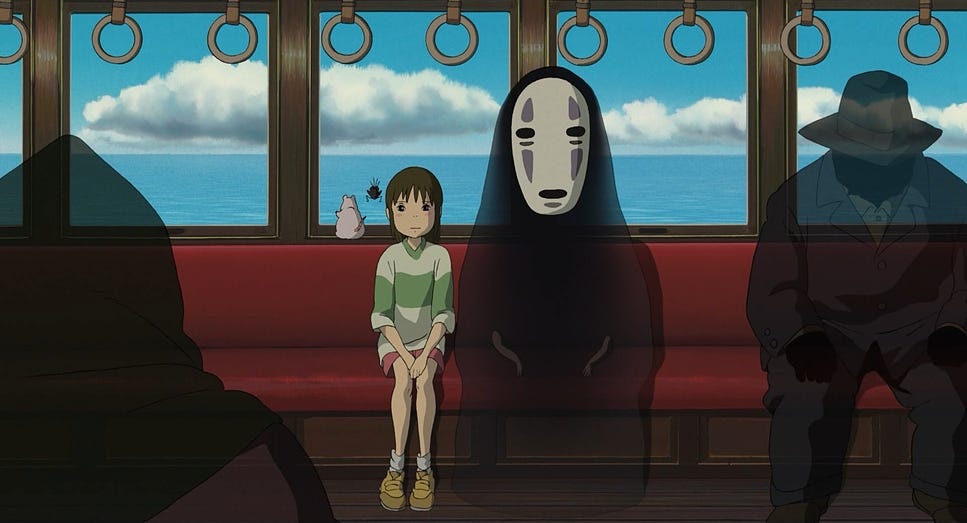
Films that the viewer loves says a lot about the viewer than the viewer may struggle to articulate verbatim. The love for certain films is more psychological and more than just entertainment. The scenes and sounds of film may represent visual and auditorial blankets for your unfulfilled feelings. Especially if those feelings are familiar. Because nothing is more comfortable than familiarity, whether that familiarity is calm, or unsettling, medicinal or poisonous, that familiarity will more likely be selected over brand new territory of challenges, because that feeling you keep on chasing time and time again, feels the most safe. Even though it can still kill you. But those fuzzy and wooly blankets that keep you warm and cozy will start losing its yarn and eventually fall off your body once the end credits begin to roll. So to solve that problem - to get that warmth back from your cold world of your personal reality - whether that reality may be boring, unpleasant, and unwanted by your point of view, and to run away from yourself, to escape your personal dread, to get that fix, you decide to watch it again... and again.. and once again.
And you find other people who may share that same love of that film as you do, and you build a bond (or tribe) where you can knit a larger blanket this time around, where the film(s) center your comfort and soothe your discomforts. And quotes from these films tattoo your vocabulary. To convey your arguments, and your unresolved problems. Lessons that place bandaids onto your agony. That agony may never heal. You crave for a cure, but that cure is just a mirage teasing you. Close enough for you to smell the scents of scenery, but too far to grasp its benefits. But it sure is nice to know that you and the environment around you is seen and you feel heard and feel recognized that this disease of uneasiness you carry is something that you can watch. Inhale. And you might pray that you may never have to exhale that feeling of relatability from your tender lungs. The complex narratives. The informative documentaries. The colorful familiarity of home videos. The gymnastic bending of animation. The ambition of indies. The simple contemporaries. The maximal high-budget epics. Whatever. Wherever.
For some folks, their love for cinema is no longer about the film itself, but more about how it makes the people around them feel. Some favorable moments for multiple families, friends, and lovers were built by the love of cinema. Or just one specific film. Cinema can be the glue to uphold the brokenshards of memories. And that is more of the priority than anything else.
Motion pictures display something that the viewer may want but never had, or something that they once had and cherished, but now it is no longer there anymore. But at least the memory (or the feeling of that memory) is archived to keep the stages of grief company. The picture is within you, and whether you know it or not, cinema has molded you into who you are. Cinema has either made you into who you want to be, or it has molded you into somebody that you do not want to be.
The intended settings and selected locations are characters too. For John Hughes’s films like Sixteen Candles (1984), The Breakfast Club (1985) Ferris Bueller’s Day Off (1986), and Home Alone (1990) the consistent character was the city of Chicago. For John Singleton, South Central Los Angeles was the consistent character for Boyz n the Hood (1991), Poetic Justice (1993), and Baby Boy (2001). For Spike Lee joints like She’s Gotta Have It (1986), Do The Right Thing (1989), Mo’ Better Blues (1990), and Crooklyn (1994), the consistent character was the city of Brooklyn.
Where do you want to go today? How much money is in your pocket? How much food is in your belly besides the fireballs of laughter or the cobwebs of desperation?
In films, what does the protagonist want? What do they not want? When we delve into narratives, whether the medium is film, literature, music, photography, painting, dance, sports, etc., we constantly search to connect, to attach, to relate, to sometimes emulate, or sometimes disdain. Some viewers may lose themselves entirely. They will shed their skin like pythons and metamorphose into a charismatic romanticized hero, anti-hero, or an ostracized villain.
They may want to become the adventurous violent womanizing asshole with yachts, a community of whores, and a fearful reputation. Or they may want to be a simple humble secretary typing on a laptop tucked inside a cubicle with no trouble and no drama, with a good 9 to 5, a 401k, and 3 kids, with a pension and a dog named Scruffy, in a quiet suburb.
What does the viewer want? In real life, we may not have the courage or we may be too shy to fully take our masks off and allow our flaws to be naked against the challenges of morals and ethics. But the stories that we love can oblige into those actions for us, and make us feel better about ourselves for the time being, either by seeing bits and pieces of ourselves into the characters on screen or having a high level of depreciation for them on screen. Your reaction to those (con)sequences are the reward. You consumed regardless. That time is brief.
The curtains of cinema uplift all of the psychological vices that we bottle up. And those vices will boldly wink to your pulse. Taboos become permissible. On the other side of the coin, compassion can become affluent, and protection becomes abundant. But none of this is guaranteed. All of it can be taken away. The viewer may feel lonely, but this world of hidden possibilities can give them a sense of conditional friendships without responsibilities, and without compromise. There might be beauty within that chaotic mess on the screen. And there might be beauty within that chaotic mess of your life. Or chaotic mess within the beauty of your life.
Cinema has a brilliant method of demanding you to look at your wounds.
And I believe we all have those wounds. Those flaws. Those vices. Those insecurities tucked inside the attic of our hearts. All wounds nonetheless. Whether they are small scratches from yesterday or third degree burns from 20 years ago, cinema commands us and reminds us that our scars may never go away, but we cannot ignore them. And we can learn how to co-habitate with them, for our own choosing. Cinema may provoke the viewer to cope with the things that they do not possess, and perhaps give the viewer the drive to chase after those goals. Messages within the narrative may park that. In the similar notion, cinema can offer clarity, and bring the viewer a perspective, to pay attention to the gifts that they do have. To hold on to them. Or let them go. Your call.
When the world of cinema is at your scope, what part(s) of yourself are you looking for? What world are you searching for? And what parts of yourself are you struggling to accept? What parts of yourself are you struggling to run away from? And what world do you wish to fly away from? What world do you wish to fly towards? What character(s) do you relate to? Does the language of the motion picture evoke or re-awaken memories of your past experiences? Does the artform reflect a particular ideology that could affirm your beliefs or challenge them? How often does cinema visualize your personal desires? How has film changed you?
Is cinema a one-way trip? Several of us sure wish it was. But it is not. It is an internal discussion between the salivation of societal chemists who construct these projects, the salivation of the viewer excavating for answers about themselves and the atmosphere around them, and the revolving doors of infinite perspectives that subjugate and center ancient ideas with fresh methods of feeling those ancient ideas intensely, or dismissing them entirely, like half-smoked cigarettes plucked into caliginous potholes.
The psychological constant loop of conversations between the viewer and the screen is an exchange of emotions of what this world is, what it ain’t, what it could be, what it should be, what it shouldn’t be, and what it is going to be.
Those interpretations of dreams, actions, and reactions will differ in various degrees. And those various degrees are political.
Because cinema is political.
There will always be an ideology throughout a cinematic narrative. Linear or non-linear. Abstract or blatantly clear. Loud and gargantuan or subliminal and hushed. The ideology of a film will always be present. Why do filmmakers and investors of films want to share certain types of ideologies in the first place? Are they aware of their motifs that kick them in the back of their hearts, or is somebody of higher power telling them to portray their hidden motivations, whether the pawn of the filmmaker agrees with the vision or not? The common problem with the politics of filmmaking is the vision of formulating the project by investors, producers and distributors usurping another vision and the desire of the project in mind, where profits come first and the artform comes second. The disagreements which often lead to conflict, is due to the spectrum of production completely lacking the experience of the story in which the project is attempting to convey to the targeted audience.
But who is the target audience? Does the targeted spectator reflect the subjected characters on the screen? Or does this sensationalized narrative (which certainly derives from a rich and interesting background of cultural interest but often reflects inaccuracies with caricatures secluded and isolated into objectification, exploitation, violence and sexualization) intentionally seek an audience who may be culturally inept - yet curious, fascinated, and aroused by the subjugated atmosphere on screen, but unaware and uninterested to the historical, political, and social contexts surrounding the narrative? Surrounding the production and surrounding the distribution of the film itself? Surrounding the atmosphere of their own world? Do they simply choose not to care and to just be entertained? Do they ask themselves why they might be consistently attracted to hyper levels of exoticism, saturated violence, sexual conquests and buffoonery, where the level of humanness is erased and absent? Because there is something inside the zeitgeist of the picture that they desire. To own. To conquer. To devour. And they may need to look at themselves and wonder why do these such desires - shallow and plain, or taboo and strange - continue to simmer in their eyes and their bodies.
The best examples of narratives are carefully crafted by the people who have the most experiences and the closest proximity to those narratives they formulate. With good intentions. The filmmakers, and the production crew from top to bottom were also part of these environments or they may know the temperatures of those environments on a personal level, or they know somebody close to them with those personal experiences. Their lenses matter. Primary sources. If they do not know and do not understand the narrative in which they themselves are working for, then they are willing to listen, ask questions, and proactively engage and study the subtexts without any form of egotistical encroachments. Otherwise, the best decision would be to remove themselves from the project entirely, and bring in somebody who does understand the narrative and the environment, without explanations nor lessons. If the narrative is a period piece, then an historian (or multiple historians) is highly suggested. No need to take up space, because the cast and crew are the space. The folks who are responsible for these freshly and correctly developed, well paced, and immaculately executed narratives know the areas around them like the back of their hand. And the target audience who feel seen and represented, is prioritized, and intentionally cared for. The atmosphere is reflected with abundance of the collective and the abundance of the people, rather than the extraction of the people to appease and profit a population where the subject is not centered. If a narrative is bound to blossom, where the subject(s) for the screen is the center of the conversation, then it is imperative to prioritize the people who relate the most to these characters in production crew for development, alongside with the people willing to watch somebody that may reflect themselves - who relate most to the intended subject.
Do not push the people in development to the margins.
Do not make the people peripheral.
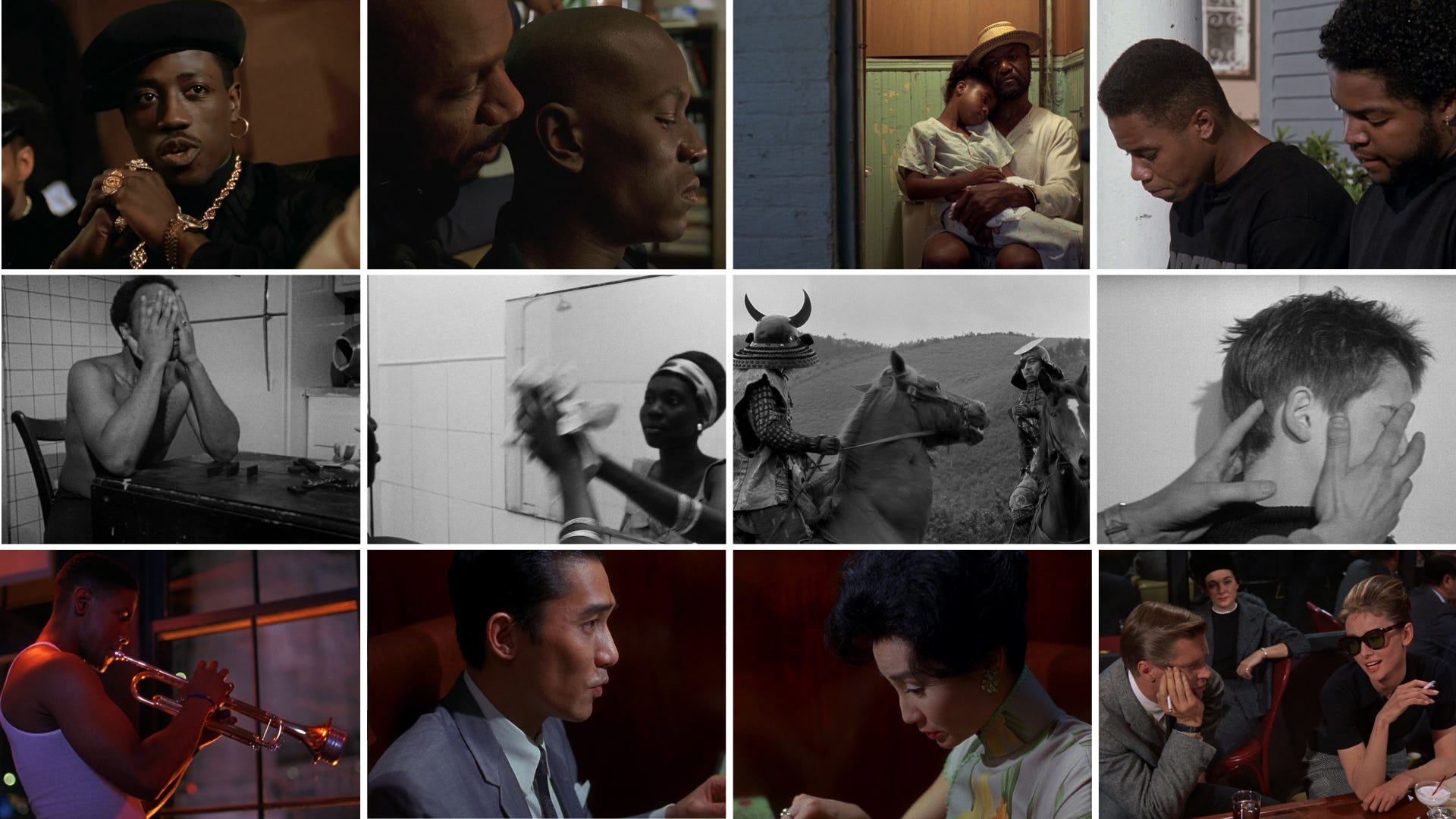
so dear reader, the question is now yours to answer, what is cinema (the art) to you?
lastly, a couple exciting pieces of news for you:
I helped put together alongside Jane Gilmore, Lauren Greenwood, Maris Lidaka, and Courtney Romano a NonDē Virtual Block Party to celebrate the community and rev everyone up for the months to come. This is gonna be a fun experiment ya’ll so if you’re free next Saturday July 25th I highly recommend RSVP’ing!
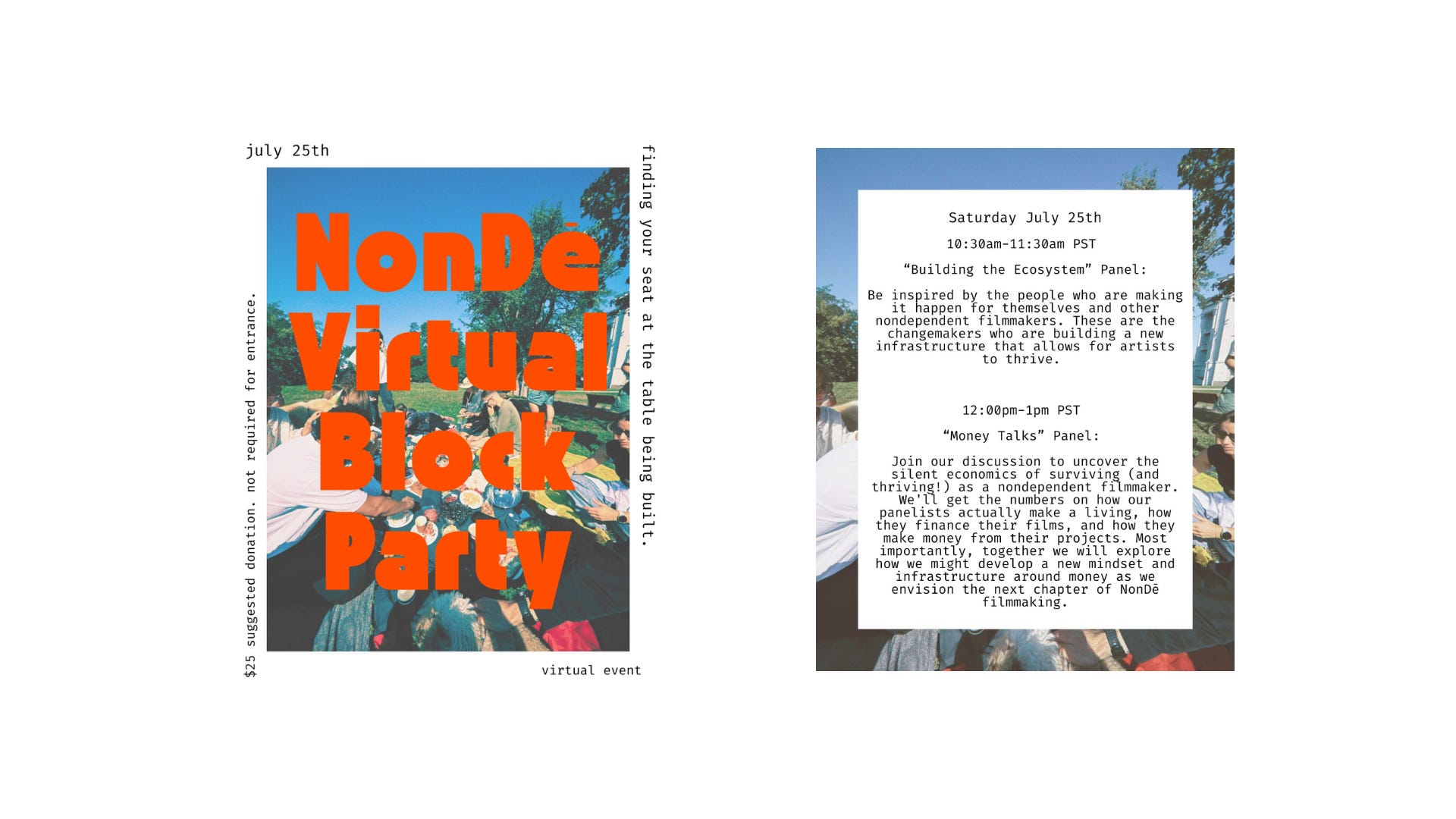
What would happen if a bunch of non-dependent (and non-dependent curious) thinkers got together in one (virtual) room, to chat (not network), to share knowledge (not hoard it), and to (gasp!) have a little fun?
Would it rev you up to have the most exciting, productive, big-swing-kinda-energy for the rest of your 2026?
Well before we get there…
You’re sitting there, feeling exhausted. It’s a lonely process to navigate this changing industry. You’re skimming the trades – for what? No idea.
You’re staring at Final Draft, Premiere, or even SubStack and wondering:
What the heck am I doing with my career?
Listen friend, you’re in good company. It’s such a common, understandable question to ask ourselves. And perhaps one that takes an entire lifetime to answer. Which is why being in community with others who are also asking these exact questions can be the antidote to cynicism, and more than that: it can be the exact hit of energy we need to keep going instead of giving up.
All over SubStack, NonDē filmmakers are making connections, sharing their wealth of knowledge, and firing up support for one another. And each time we get together, it adds up to something bigger than each one of us: a brand new cinematic ecosystem for filmmakers.
We think it’s time to power up, but before we get there…
4 Things You Should Know About NonDē Filmmaking
You don’t have to give up your current trajectory to be a NonDē filmmaker. It’s an additive strategy. You can keep pursuing film at all levels: making your own smaller projects while you wade through development with larger production companies and studios. But beware: you may find creative fulfillment and new opportunities for financial returns making non-dependence a much more exciting option.
Non-dependence can be applied to all budgets. Non-dependent films range from $1000 to 7-figure budgets. It’s not the budget that determines non-dependence, it’s the retaining of your rights, going direct to audience, and benefitting from the financial return. While the market may dictate that a lower-than-industry-standard budget is best to start with, non-dependence does not prescribe any budget level.
You know how to “do” non-dependence already. If you’ve written spec scripts, shot a short, or started building your audience, you’re already doing some of this work. What you may not have done yet is made friends who are also doing this work. But trust, there are plenty of filmmakers just like you out there. Some might even call this a wave. ;)
New non-dependent infrastructure is getting built all the time. New ideas (and the infrastructure to implement them inexpensively and with ease) are popping up monthly! Being in a community who’s talking about these things keeps you at the forefront of change in a rapidly shifting industry.
So without further adieu, you and your NonDē curious friends are invited to the first annual NonDē Summer Virtual Block Party!
General Info
Saturday, July 25th Schedule (all times in PST)
10am-10:30am: Welcome + Keynote
10:30am-11:30am: Building the Ecosystem Panel
12:00pm-1pm: Money Talks Panel
1:30pm-2:30pm: Closing Block Party & Mixer
10:30am-11:30am (1:30pm-2:30pm): “Building the Ecosystem” Panel
Is this event free or paid?
It’s Pay What You Can with a suggested donation of $25.
What does the cost of the ticket go towards?
Tickets cover overhead administrative costs and provide a small stipend to the organizers and panelists. All additional funds will be donated to Intrinsic Entertainment’s Letterboxd campaign.
What if I can’t attend all the sessions?
So you want to be the cool kid who arrives stylishly late? We see you and we support you! Even if you decide to pull an Irish goodbye and slip out the back door a bit early, come for every part you can and go when you gotta go!
Are you recording this?
We will be recording the sessions and plan to offer the ability to purchase the recording in the future.
Where is the Block Party?
It’s VIRTUAL, baby! THINK: A chat on fire, a mixer with many small rooms to wander in and out of, and of course an inspiring line-up of filmmakers who are making it happen for themselves and others.
Will I have to be on screen?
While obviously we love to see your pretty faces and it will make it easier to interact with our panelists, you are welcome to chill out and watch things from your lawn chair, sipping a frozen lemonade, shades down, screen off.
Is this an educational program or a party?
The best of both worlds: a party where you might learn a little something and walk away inspired and with new friends!
Can I invite my friends?
Please do, EVERYONE is welcome! Let’s expand our NonDē world and try to introduce non-dependence to novice filmmakers AND industry professionals who don’t yet know what they’re missing out on.
Do I have to be on SubStack to attend?
All you need is the ability to join a zoom room! But we can’t promise you won’t be inspired to create a SubStack to keep those connections going on the daily.
Who is organizing this?
Jane Gilmore is a screenwriter, teacher and mother who excels at curating meaningful experiences, which means she throws kick-ass birthday parties and can get a room full of reluctant writers to rage on the page. She is inspired by fierce females, shows that make you laugh and then ugly cry, and literally anyone who has the moxie to turn their art into reality. It’s from this place of admiration that she runs Females in Film & Television, a FilmStack publication dedicated to amplifying the voices and stories of women making it happen for themselves in film & TV.
Lauren Greenwood is a professional screenwriter and newbie director. She writes TV movies, features, shorts, YouTube and works as a story editor and a copywriter and she recently directed her first short SWATHE. Lauren writes the Substack newsletter CUT TO: Writing a Movie where she overshares about writing TV movies and provides in-depth and practical guides for screenwriters at all stages.
Taylor Lewis is an artist, entrepreneur, and maker of cinema. Her first two short films, Blue Moon (2022) and Four Stages of Fire (2020), both had award-winning festival debuts and explore how everyday people are pushed to the edge. Please Stay is her latest short about a woman in the midst of an existential crisis and received the LA Filmmakers Grant at VisionFest. In between projects, she runs the publication Luz Films Mag where she puts cinema back into the cultural conversation and spearheads an alternative distribution project called The Circuit.
Maris Lidaka Writer of The Sovereign Creator and creator of The Blended Future Project. He uses his experience as a 20 year veteran of the entertainment industry to build ecosystems around creativity.
Courtney Romano is a writer/director. She’s also worked as a consultant, producer, and strategist on everything from NonDē films to celebrity projects. She runs the NonDē 50 Films Project, a coalition of now 120+ filmmakers dedicated to producing and coordinating 50 non-dependent films this year. In addition to her own film-related Substack, Let’s Go Again, she edits and curates FilmStack Daily Digest, and writes about death/grief on Messier Objects. This year, she’s making her first feature film.If you’re ready to wrap up the last few months of 2026 with good vibes, solid strategies, and a growing community of like-minded collaborators, don’t miss this!

We’ve almost hit the 100k needed for legal fees to make a bid to buy Letterboxd and if we, the people, can get behind and excited about helping pay for legal fees…
well then…a community-owned Letterboxd is just around the corner.
To me cinema is a fairly new art form that has not toughed its potential to move people. It can do so much more than just entertain. We need more movies that matter. Movies that are a movement for positive change. Movies that uplift, inspire and make us believe that anything is possible. We need more "solution-based" cinema.